Moramanga is a Malagasy urban commune, the capital of the Moramanga district, located in the south-central part of the island of Madagascar.
General context of life in Madagascar
Figures from the WHO, IMF, and World Bank prove the decline over the years in all human development indices for Madagascar. This is despite all the international aid that has been reaching various ministries for years.
Political leaders and elites send their children to study in Europe or the United States. Mineral wealth is negotiated between politicians and foreigners, but nothing from these contracts benefits the local populations.
In order to protect their interests, they have no advantage in the people having access to more education, healthcare, or even communication infrastructure.
This reality inevitably leads to population resilience, which intensifies each person's «get-by» system. In this context of resourcefulness, corruption is accepted by the majority of the people, who will use it at the first opportunity or benefit from it without batting an eye.
Responsibility for the decline is now shared between most politicians and also the majority of Malagasy people themselves. These causes are becoming endemic and are torpedoing a large part of the good actions taken to combat so much chronic misery.
The outcome of change can only be foreseen by making young people aware of the benefits of honorable behavior for themselves and their nation.
In this context, Teaching assistance is essential.
How can we imagine the country's development without training young people, not only for positions of responsibility but especially in solidarity and a sense of service?
It will take several generations, no doubt, but it is by helping them in this way that hope is possible.
It is in this lucid hope that all good wills and the diocese work with self-denial, faith, and determination. The dioceses, with the support of charitable works, associations, NGOs, and missionary congregations, are undertaking the bulk of the actions that respond to human emergencies through the fight against malnutrition and illiteracy, and are also undertaking, for the long term, a program to support and train students.
Our call today focuses on 2 concrete and essential actions :
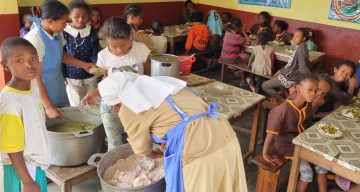
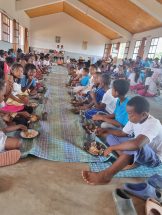
Funding for school canteens that combat malnutrition from an early age by purchasing bags of rice, and funding for the necessary shelters; ;
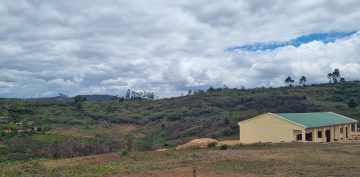
2/ Financing the construction of Don Bosco University in Moramanga: roofing and purchase of interior furnishings.
In detail, our actions
School canteens
Family incomes are extremely low, with many having only one rudimentary meal a day. Children suffer from chronic malnutrition, which irreversibly leads to a weak immune system, stunted growth, and significantly reduced learning abilities.
Associating a canteen with each school created allows children to have the opportunity to access an additional, more balanced meal per day.
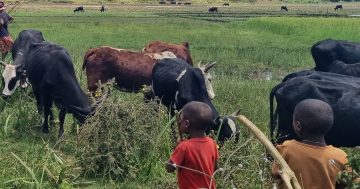
Canteens are, in fact, also one of the ways to motivate families to send their children to school, who normally have to help with work in the fields, or tend to the zebu in the wild from the age of 7.
The Diocese often covers all canteen costs and, for the poorest families, all tuition fees.
For remote villages, distances increase the obstacles to schooling, which requires multiplying bush schools and, each time, involves building, finding and paying teachers, and covering school canteens.
University
Until now, the closest university was in the capital, Antananarivo, more than a 5-hour drive away, imposing unaffordable housing costs on families.
As a result, young high school graduates were forced to look for odd jobs to finance accommodation and transportation, help their families with farm work, or, for the most destitute, engage in much more lucrative but... extremely detestable activities (drugs, pornography, all kinds of prostitution).
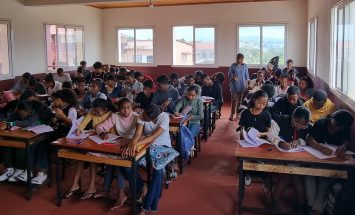
Currently, 260 students are already «housed» temporarily in cramped facilities across 4 classrooms with over 60 students each, while awaiting the construction of buildings fully adapted to the ever-increasing student population.
In line with Don Bosco's message, enrollment remains possible throughout the year to ensure young people do not lose their acquired knowledge, fall into idleness, or interrupt their education. They will also receive an introduction to their sense of responsibility, their dignity, and their potential to serve many ethical causes at the end of their studies, both within their own region and in the city of Moramanga.
For 30 years, the diocese has carried out many school constructions, school canteens, and dispensaries. These achievements have been realized by congregations, but they lack teachers, doctors, nursing staff, administrators, etc., to meet the exponential growth of a population where 65% are under 18%.
These positions of responsibility, accessible to academics, will in turn allow for the continuation of teaching in a spirit of solidarity, which will gradually overcome the dishonest behaviors currently prevalent in the adult world.